Medically Reviewed By: Dr Marie-Clair Murphy
May is Skin Cancer Awareness Month, and it’s the time of year most of us start noticing our skin again. A spot on the cheek that wasn’t there last summer. A mole that looks slightly different. A brown patch on the back of the hand that’s hard to place. Around 20,000 melanoma cases and 156,000 non-melanoma skin cancer cases are diagnosed in the UK every year, according to Cancer Research UK, and rates are still climbing.
If you have a mole or skin change that has been growing, bleeding, itching, or visibly changing over weeks or months, the next step is to see your GP.
The NHS has an urgent pathway for exactly this reason, and it works. For everyone else, what follows is a calm walk through what’s usually benign, what isn’t, and your options if you’d like a professional opinion.
In this article
- What the Sun Does to Your Skin (the Short Version)
- The Benign Things People Commonly Notice
- What to Look Out For: The ABCDE Rule
- Other Changes Worth Showing Your GP
- Where to Go: Two Legitimate Routes
- What Our Minor Surgery Service Actually Does
- What Aesthetic Treatment Can Help With (Once You Have Clearance)
- Prevention is the Only Intervention that Matters in the Long Run
- A Simple Self-Check Routine
- FAQs
- Closing
What the Sun Does to Your Skin (the Short Version)
Two types of ultraviolet light reach us. UV-A drives the visible ageing changes: collagen breakdown, uneven pigmentation, and fine lines. UV-B causes sunburn and the DNA damage behind most skin cancers.
According to Cancer Research UK, too much UV radiation causes around 85% of melanomas in the UK, and the risk is higher in people who have been sunburnt several times, at any age.
Childhood sunburn carries particular weight: research cited by Melanoma Focus suggests that even one blistering sunburn in childhood or adolescence more than doubles the risk of developing melanoma later in life.
The Benign Things People Commonly Notice
Most pigmentation changes are not cancer. Knowing what benign looks like helps you recognise when something isn’t.
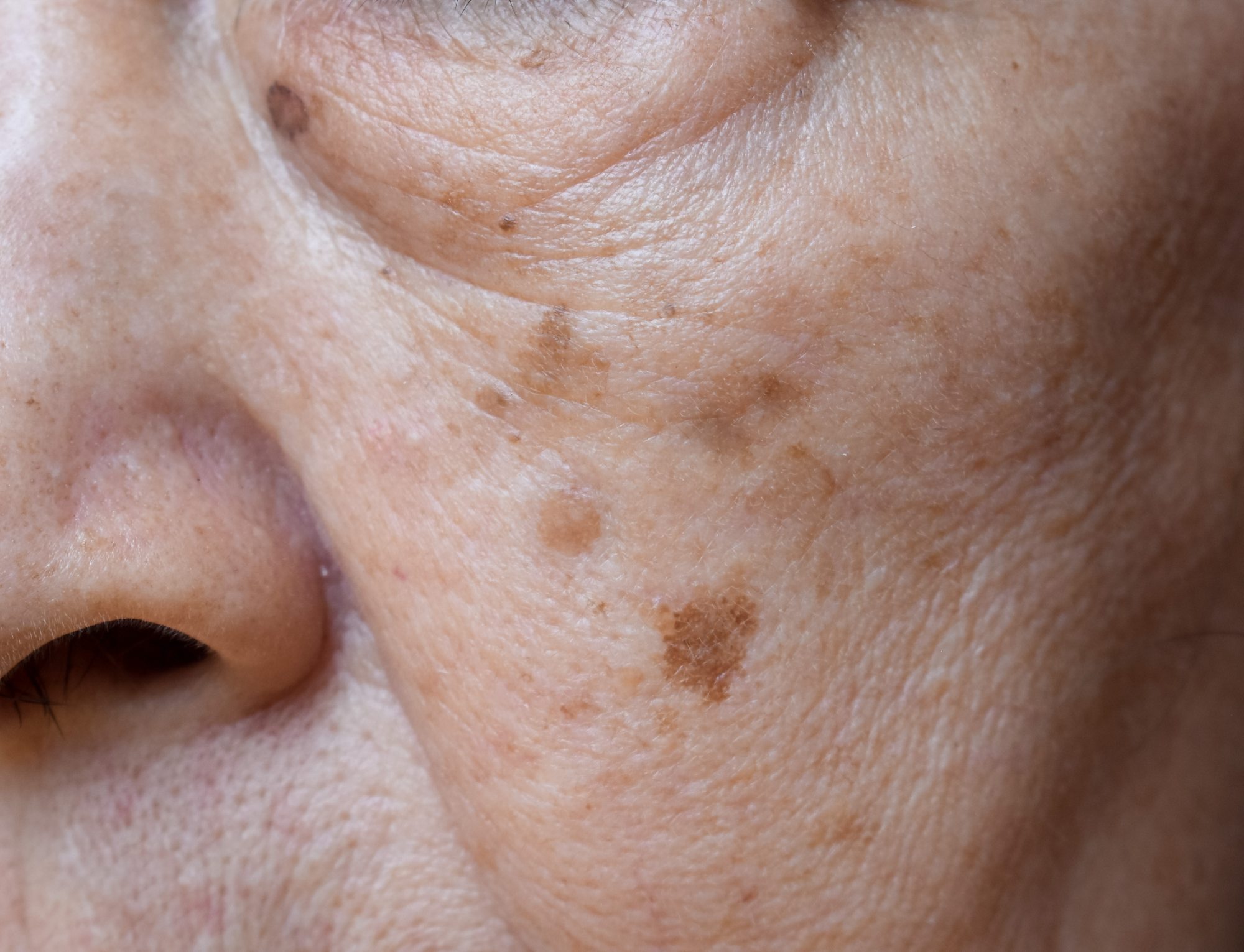
Solar lentigines, or age spots, are flat, evenly pigmented brown marks with sharply defined edges, on the backs of the hands, the face, and the décolletage. They stay much the same year to year.
Seborrhoeic keratoses are raised, waxy, and often described as looking “stuck on”. They develop slowly but are harmless.
Freckles are small, light brown spots that appear in clusters on sun-exposed skin and often fade throughout the winter.
Melasma is defined by larger, symmetrical patches on the cheeks, forehead, or upper lip, strongly linked to hormones. It’s common in pregnancy or with the contraceptive pill.
Cherry angiomas are small, bright red, slightly raised spots that become more common after the age of thirty. These collections of tiny blood vessels are fully benign.
What to Look Out For: The ABCDE Rule
ABCDE is the standard self-check used by dermatologists worldwide, recommended by the British Association of Dermatologists and Cancer Research UK. Any one of these signs is reason enough to get something checked. You don’t need to tick multiple boxes.
A is for Asymmetry. If the two halves of your mole or abnormal patch of skin don’t match, take note. Melanomas tend to have an uneven shape.
B is for Border. Benign moles have smooth, uniform edges. Irregular, ragged, notched, or blurred borders are worth a closer look.
C is for Colour. Most ordinary moles are one shade of brown. Multiple colours within a single lesion, such as patches of black, red, white, or blue, should be shown to a doctor.
D is for Diameter. Anything larger than 6mm, roughly the width of a pencil rubber, merits attention. Melanomas can be smaller, so size alone isn’t the whole story.
E is for Evolving. Often, the most useful sign. Any change in size, shape, colour, or elevation over weeks or months, or new symptoms such as bleeding, itching, or crusting, warrants a GP visit.
There’s also the “ugly duckling” sign. Most of your moles will look broadly similar. If one stands out as visibly different, it’s worth showing to a doctor, even if it does not meet the ABCDE criteria.
Other Changes Worth Showing Your GP
Non-melanoma skin cancers are far more common than melanoma but typically less dangerous. They still need treatment, and they often look less dramatic than people expect, which is why they get missed. Macmillan provides accessible patient information on both types.
Basal cell carcinoma usually appears as a small, pearly bump, sometimes with visible blood vessels or a central depression. It grows slowly and is most often on the face, ears, or neck.
Squamous cell carcinoma tends to look like a scaly, crusty patch or a sore that doesn’t heal, and may bleed. It’s most common on sun-exposed areas.
Actinic keratoses are rough, scaly, often slightly pink patches that can be a precursor to squamous cell carcinoma.
Where to Go: Two Legitimate Routes
If you’ve decided you want a professional opinion, there are two sensible routes for different situations.
The NHS GP is the right first call if anything has changed or doesn’t look right. It’s free, and your GP can refer you urgently via the NICE NG12 wait pathway where appropriate. If something ticks any of the ABCDE markers, or a sore isn’t healing, this is the route. There is no faster or more appropriate option for anything your GP might want assessed urgently.
Private minor surgery with histology is a viable choice for a variety of instances: a doctor-led assessment of a specific lesion that isn’t obviously NHS-urgent, or removal of a mole for cosmetic reasons or because it catches on clothing. The benefit is continuity in one clinic: assessment, removal under local anaesthetic, and histology in one place, on a timeline that suits you.
An important commitment: if we assess your lesion and decide it needs the NHS pathway, we will tell you and refer you back to your GP rather than treat. Private minor surgery is not a substitute for NHS cancer pathways, and we don’t market it as one.
Want to talk it through with a doctor?
If this is something you are dealing with, a consultation at our doctor-led clinic is a straightforward way to understand your options, with no obligation to treat.
What Our Minor Surgery Service Actually Does
Consultation comes first: medical history, dermoscopic examination where appropriate, and a clinical judgement on whether private removal is right or the NHS route is more appropriate. Most cosmetic removals can be performed in the clinic by our GP. However, depending on the location and complexity of the lesion, some may be better referred to a plastic surgery specialist, and we will advise you if that’s the case.
Removal is done under local anaesthetic and typically takes 20 to 45 minutes. Every excised lesion is sent to a UKAS-accredited histology laboratory as standard. This is the part patients often value most: you don’t leave wondering what was there. Results are reviewed by the clinical team and shared with you, with aftercare and follow-up included.
The service covers benign moles, sebaceous cysts, lipomas, skin tags, warts, milia, cherry angiomas, seborrhoeic keratoses, and diagnostic biopsies. It does not cover skin cancer treatment. If histology returns abnormal findings, we refer you onward to NHS dermatology or appropriate specialist care.
Prices start from £280, with no referral needed, and appointments are bookable directly.
What Aesthetic Treatment Can Help With (Once You Have Clearance)
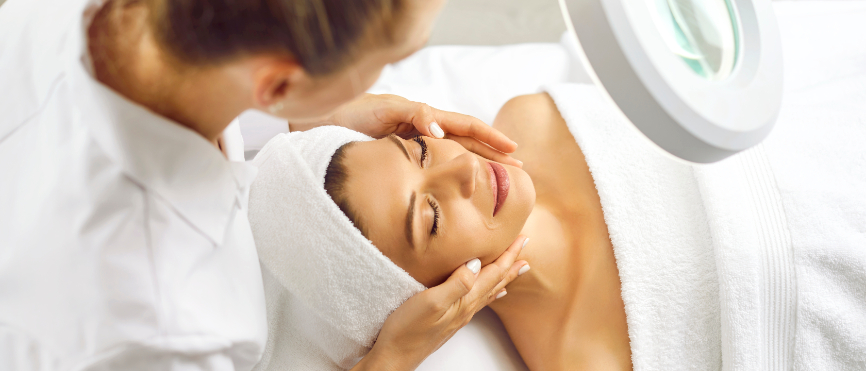
We offer connected layers of care: assessment and removal under our minor surgery service, with histology as standard; and then, once a lesion has been confirmed benign or where the question was always cosmetic, treatment for the surrounding sun damage and pigmentation. The aesthetic layer follows the medical one. It doesn’t replace it.
For diffuse sun damage and pigmentation, BBL HEROic is well-established. MOXI is gentler and helps with tone and surface texture. Tixel offers deeper resurfacing for more profound changes, Hydrafacial gives a lighter surface improvement, and chemical peels can help with melasma, though they need to be used carefully since melasma can rebound if treated aggressively.
Prevention is the Only Intervention that Matters in the Long Run
Treatment is reactive. The only way to reduce lifetime risk is to prevent it in the first place.
Daily broad-spectrum SPF 50 is the foundation, and it isn’t just for holidays. UV-A reaches your skin through cloud cover and through car and office windows.
Reapply every two hours during exposure, pay attention to the UV index (the Met Office publishes it daily), and avoid sunbeds entirely; the World Health Organization classifies them as a Group 1 carcinogen.
Antioxidant skincare with vitamin C and niacinamide supports sun protection but doesn’t replace it. Family history also matters, so ask your parents and siblings whether anyone has had a skin cancer diagnosis.
A Simple Self-Check Routine
Once a month, in good light and in front of a full-length mirror, undress and work through your skin systematically. Face, ears, and scalp (parting your hair). Hands, including nails, then arms and underarms. Chest, abdomen, and skin folds.
Use a hand mirror, or ask a partner, for your back. Down the legs, including the backs of thighs and behind the knees. Finish with feet, soles, and between the toes.
If there’s a mole you want to track, take a photo at the same lighting and distance, so you have something to compare next month.
FAQs
Can age spots turn into skin cancer?
No. Solar lentigines are fully benign. Their presence does indicate significant sun exposure, which is itself the biggest risk factor for skin cancer.
Should I have a mole removed for cosmetic reasons?
You can, and it’s reasonable if the mole annoys you or catches on clothing. Removal should always be performed by a doctor, and the lesion should be sent for histology, so the cosmetic decision still gives you diagnostic information.
Do you send every mole removal for histology?
Yes. Every excised lesion is sent to a UKAS-accredited laboratory as standard, regardless of how it looks clinically.
What happens if histology comes back abnormal?
We discuss the results with you and refer you to NHS dermatology or the appropriate specialist. We don’t treat skin cancer at the clinic.
How much does private mole removal cost?
At Light Touch Clinic, minor surgery starts from £280. The final price depends on the lesion, its location, and the complexity of the removal.
What does early melanoma actually look like?
Often fairly unremarkable. Many early melanomas are small, flat, and not especially dark. The key features are change over time, irregular borders, more than one colour, and the ugly duckling sign. This is why monthly self-checks matter.
Does SPF really prevent skin cancer?
Regular use of broad-spectrum SPF lowers the risk of both melanoma and non-melanoma skin cancer. It isn’t the only factor, but it’s the single most effective everyday intervention.
Speak to our medical team
Book a consultation at our CQC-registered clinic in Weybridge to talk through your symptoms and options with a doctor, including when a GP referral is the better route.
Closing
Most marks on your skin are insignificant. Some deserve a closer look. The five minutes a month you spend checking your own skin is the most powerful thing you can do. If something has changed, see your GP first. The NHS pathway exists for a reason, and it’s the right starting point for anything that ticks an ABCDE box.
If you want a private assessment of a lesion that isn’t NHS-urgent, or you want a mole removed for cosmetic or comfort reasons, our minor surgery service is available. Every lesion we remove is sent for histology as standard, so you’re never in the dark about what was there. Once you have clearance, we can help with the cosmetic side, too.