Stretch marks often fade and become less noticeable over time. Although they rarely disappear completely, the right treatment may improve their colour and texture, with results depending on the marks themselves and your skin.
Perhaps they arrived with a growth spurt, pregnancy, weight change or a dedicated few months in the gym. Perhaps they have been there for years, and warmer weather has simply made you more aware of them again.
Searching for ways to fade stretch marks can uncover a confusing mix of miracle creams, home remedies and bold treatment claims. This guide cuts through the noise, explaining why stretch marks form, what may help and what results you can realistically expect.
What Are Stretch Marks and Why Do They Happen?
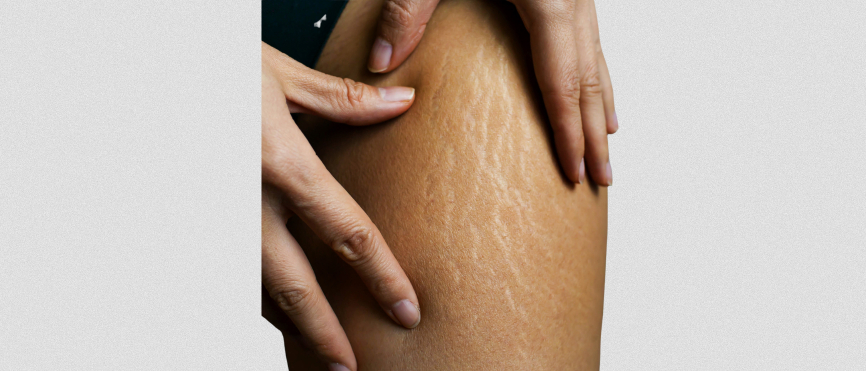
Stretch marks develop when skin stretches or shrinks faster than it can adapt. The sudden change breaks down collagen and elastin in the dermis, the skin’s supportive middle layer, and narrow streaks appear where that support has given way.
Puberty, pregnancy, weight change and rapid muscle gain are the classic triggers, and genetics largely set how prone you are in the first place. Rapid weight change in particular tends to leave its signature in more places than one, affecting your face as well as your body.
Stretch marks are extremely common, medically harmless and affect men as well as women. For a full overview of causes, symptoms and the options available at our clinic, visit our stretch mark removal treatment page.
Red vs White Stretch Marks (and Why It Matters)
Newer stretch marks are often red, purple, pink or brown, depending on skin tone, and are commonly called striae rubrae. As they mature, they usually become paler, flatter or slightly indented, settling into the silvery-white lines known as striae albae.
That colour change matters for treatment. In a red mark, the blood supply is still active, so there is colour to target with light-based approaches. In a white mark, the inflammation has subsided, the blood supply has receded, and what remains is a settled scar.
With little colour left to work on, these marks may respond better to approaches that remodel collagen and rebuild texture from within. Colour gives a useful indication of stage, but treatment also depends on texture, location, skin type and pigmentation risk.
Do Stretch Marks Go Away on Their Own?
Partly. As the NHS explains, stretch marks typically fade over time from red or purple to a paler, silvery tone, but they rarely disappear completely. The itching many people notice early on is a normal part of the process as the skin stretches and heals.
So, untreated marks do become less obvious, just slowly and not entirely. Professional treatment aims to take that natural fading further and faster than the skin manages on its own.
Do Stretch Mark Creams and Oils Actually Work?
In studies reviewed by the American Academy of Dermatology, popular remedies such as cocoa butter, olive oil, almond oil and vitamin E made no difference to stretch marks, and the evidence that they prevent marks from forming is just as thin. The NHS takes a similar view: there is little evidence that most creams and lotions work.
There are modest exceptions. Some early-stage marks may become less noticeable with certain retinoid-based products or hyaluronic acid, applied consistently over weeks to months. These are far from a guaranteed fix; they do little for mature white marks, and retinoids must not be used during pregnancy or while breastfeeding.
None of this means moisturising is pointless. Hydrated skin feels more comfortable and itches less, which matters when marks are new. It is simply skincare rather than treatment, and it is worth knowing the difference before spending heavily on a jar of hope.
Which Treatments Can Actually Fade Stretch Marks?
We use four approaches for stretch marks, each doing a different job. A consultation decides which suits your marks, your skin type and your goals.
RF Microneedling
RF microneedling combines fine needles with radiofrequency energy delivered deep into the dermis, prompting the skin to produce fresh collagen exactly where stretch marks have broken it down. It’s one option for improving the texture of mature stretch marks by creating controlled dermal injury and stimulating remodelling. Our guide “Microneedling, Is It Right For Me?” explains what the process involves in detail.
Platelet-Rich Plasma (PRP)
PRP uses growth factors taken from a small sample of your own blood to support collagen production and skin repair. It is often combined with microneedling to enhance the improvement in stretch mark texture and tone, giving the skin’s healing response extra raw material.
BBL HEROic and MOXI
For newer marks that are still red or purple, BBL HEROic and MOXI work as a pair: BBL broadband light targets the underlying redness to help fade the colour, while MOXI’s gentle fractional laser works on surface texture. This route may be most effective in the early, red stage, before marks turn white, which is why acting sooner can genuinely help.
Exilis Skin Tightening
Stretch marks often arrive alongside loose, lax skin, particularly after pregnancy or weight change. Exilis uses radiofrequency energy to firm and tighten the surrounding skin. It does not treat the marks themselves, but it complements the treatments above, so the whole area looks smoother and firmer.
Whichever route suits you, expectations should stay realistic. These treatments improve stretch marks rather than remove them. Results build over several months as collagen regenerates. Outcomes vary with the age, colour and severity of the marks, and with your skin type.
Can Stretch Marks Be Treated on Darker Skin?
Yes, but the treatment and settings must be selected carefully. Darker skin is not automatically unsuitable for stretch mark treatment, although it may be more prone to post-inflammatory hyperpigmentation after procedures that create heat, inflammation or controlled skin injury.
A practitioner should assess more than ethnicity or visible skin colour. Relevant factors include Fitzpatrick skin type, any previous pigmentation changes following injury or treatment, a history of raised scars, recent tanning and the condition of the treatment area. Conservative settings or a test area may be appropriate for some energy-based treatments.
Newer Marks or Older Marks: Which Route Suits Which?
A simple rule of thumb. Red and recent leans light-based: BBL and MOXI can work on the colour while it is still there, so it pays to act sooner rather than later. White and settled leans remodelling: RF microneedling does the structural work, often with PRP added to support it.
In reality, many people have a mixture, perhaps faded marks from their teens alongside newer ones from a recent change, and a consultation is where a practitioner maps what you have and sets the order of treatment.
Can You Prevent Stretch Marks?
Not reliably, and anyone who promises otherwise is overreaching. Genetics play the biggest role in whether your skin marks under strain. Keeping weight change steady where you can gives skin more time to adapt, which helps. Beyond that, the evidence for prevention creams is weak: as covered above, the popular candidates did not prevent stretch marks in studies. Look after your skin, stay realistic, and know that if marks do appear, there is a range of options.
When Should You See a GP or Speak to a Practitioner?
Most stretch marks are harmless and do not require medical treatment. However, large stretch marks should be assessed by a GP if they appear alongside other changes such as:
- More fat around the chest and abdomen, with comparatively slim arms and legs
- A build-up of fat around the back of the neck or shoulders
- A red, puffy or rounded face
- Skin that bruises easily
- Noticeable muscle weakness
These can, rarely, be symptoms of Cushing’s syndrome. Stretch marks can also be associated with prolonged use of some steroid creams or tablets. Do not stop prescribed steroid medication without medical advice, but speak to the clinician who prescribed it if you are concerned.
Where there are no medical warning signs and the concern is cosmetic, a practitioner can assess the colour, texture and age of the marks, your skin type and your pigmentation risk. They should explain which options may help, the likely treatment course, possible downtime and when the expected benefit would be too limited to justify treatment.
Aesthetic procedures are generally deferred during pregnancy. If you’d like a professional opinion, we are a doctor-led, CQC-registered clinic in Weybridge, Surrey. Book a consultation to talk through your options with our team.
Frequently Asked Questions
Do stretch marks go away on their own?
They fade, but they rarely disappear completely. Over months to years, red or purple marks usually settle into paler, silvery lines that are far less noticeable. Professional treatment can take that fading further and faster, though no approach returns the skin exactly to how it was before.
Can stretch marks be removed completely?
No. No treatment can guarantee complete removal, and any clinic promising it should be treated with caution. What professional treatments can do is significantly reduce the visibility and improve the texture of stretch marks, with results varying by their age, colour and severity and by your skin type.
Do stretch mark creams work?
There is little evidence that most creams and lotions remove stretch marks, and studies found that popular remedies such as cocoa butter and vitamin E did not prevent them either. Some early marks may improve modestly with certain retinoid-based products, which are not suitable during pregnancy or breastfeeding.
What is the best treatment for old, white stretch marks?
Older, white marks generally respond best to collagen-remodelling approaches such as RF microneedling, often combined with PRP to support skin repair. Because there is no redness left to target, improvement comes from rebuilding texture, which develops gradually over the course of sessions.
Can you treat stretch marks during pregnancy?
Aesthetic treatment is generally deferred during pregnancy, and retinoid-based products should also be avoided while pregnant or breastfeeding. The good news is that marks that appear during pregnancy are new, and newer marks tend to respond well, so a consultation after your baby arrives can help plan the right timing.
How many sessions does stretch mark treatment take?
Typically 3 to 6 sessions, but the exact number depends on the treatment chosen and on the age, colour and severity of your marks, which is what a consultation is for.
How much does stretch mark treatment cost?
Stretch mark treatment at our clinic starts from £350, with the overall cost depending on the treatment recommended, the size of the area and the number of sessions you need. You will receive a clear, personalised quote at your consultation before committing to anything.